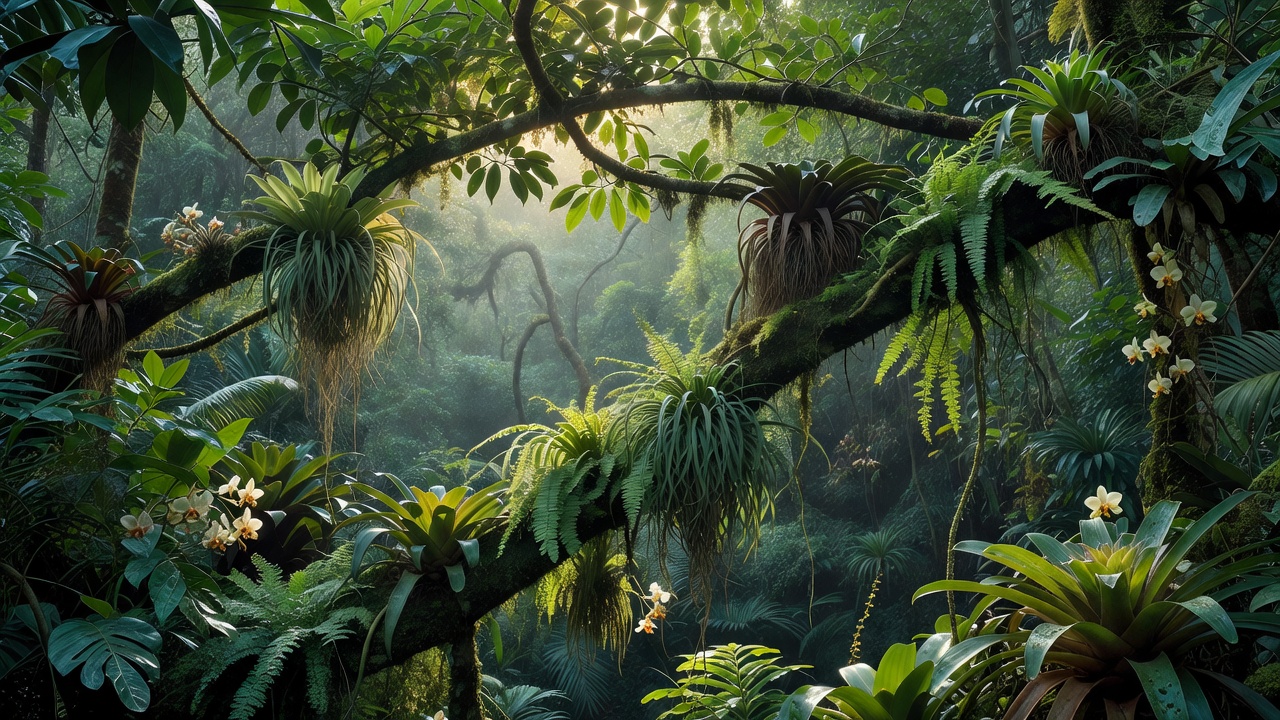
The first useful thing a guide may do on an elevated platform is ask everyone to stop moving. A branch that looked empty begins to reveal leaf edges, a suspended root or the outline of an insect. Without changing location, the group has entered a more detailed forest. This is the promise of canopy interpretation: not guaranteed spectacle, but a better way of paying attention.
A living roof with open edges
The canopy is formed by tree crowns, but it is not a uniform ceiling. Gaps appear when branches fall, trees die or a slope changes exposure. Some crowns rise above their neighbours. Others occupy shaded space below. Light, wind and moisture vary across these small distances, creating different conditions for leaves and for the organisms that live around them.
Diagrams divide a tropical forest into emergent, canopy, understory and forest-floor layers. That is a useful beginning, not a set of sealed compartments. A liana connects ground and crown. An animal carries seeds between trees. Rain washes material downward, while roots draw water and nutrients from below. Ask your guide to show a connection between levels rather than simply naming each layer.
Plants living on plants
Epiphytes grow on other plants for physical support. Many orchids, bromeliads and ferns use this way of living, although those groups also contain species with other habits. Being supported by a tree does not automatically make a plant a parasite. The distinction matters because a crowded branch can otherwise look like a contest in which every resident is taking directly from its host.
Some epiphytes collect water or organic material around their roots or leaves. These pockets can create small habitats of their own. Conditions differ sharply between an exposed branch and a sheltered fork. Resist the temptation to pull a plant closer for a photograph. A guide can interpret its position without disturbing a slow-growing arrangement of roots, leaves and accumulated material.
Movement is part of the habitat
Tree crowns are routes as well as resting places. Birds may cross a gap readily, while a small animal that depends on connected branches faces a different landscape. Fruiting and flowering patterns influence where animals spend time. A quiet platform does not mean the forest is empty; activity may be distant, concealed, seasonal or simply happening outside the visitor’s short observation window.
Local knowledge helps put an encounter into context. A guide might recognise a call before anyone sees its source, or explain that a familiar feeding tree is not fruiting now. This knowledge is valuable without becoming a promise. Avoid asking guides to approach nests, use repeated playback or disturb wildlife to produce a sighting. The quality of interpretation is not measured by the length of a species list.
Different forests, different expectations
Monteverde in Costa Rica is associated with cloud-forest conditions, where moisture, elevation and exposure shape what visitors notice. Danum Valley in Sabah offers a different lowland tropical setting, including tall dipterocarp trees. Neither place should be treated as a template for every rainforest. The same word, “canopy,” can describe very different structures and visitor experiences.
At La Selva Biological Station in Costa Rica, research has helped illuminate tropical forest processes over time. Panama’s Barro Colorado Island, associated with the Smithsonian Tropical Research Institute, is another important setting for forest research. These are useful reference points for learning, not an implication that every research area is open for casual visits. Access rules and visitor programmes must be checked with the responsible institution.
Turn your view into an observation
Choose one branch and describe what is actually visible: leaf shape, a gap, a climbing stem or a patch of shade. Then separate observation from interpretation. “Something has eaten this leaf” is a different claim from identifying the animal responsible. Asking what evidence supports an explanation makes room for uncertainty and gives your guide a better opening than requesting a dramatic story.
Carry that habit back to ground level. Fallen leaves, seedlings and decomposing wood belong to the same system you saw above. An elevated visit becomes richer when it does not end at the last platform. The view is a beginning; the forest’s connections are the subject.
Sources & further reading
- Royal Botanic Gardens, Kew — plant diversity and botanical learning.
- Smithsonian Tropical Research Institute — tropical ecology and Barro Colorado research context.
- Organization for Tropical Studies — La Selva and tropical research education.
- Monteverde Cloud Forest Biological Reserve — local habitat and visitor information.
These sources support background reading. They do not establish current access, weather conditions or a relationship with this journal.