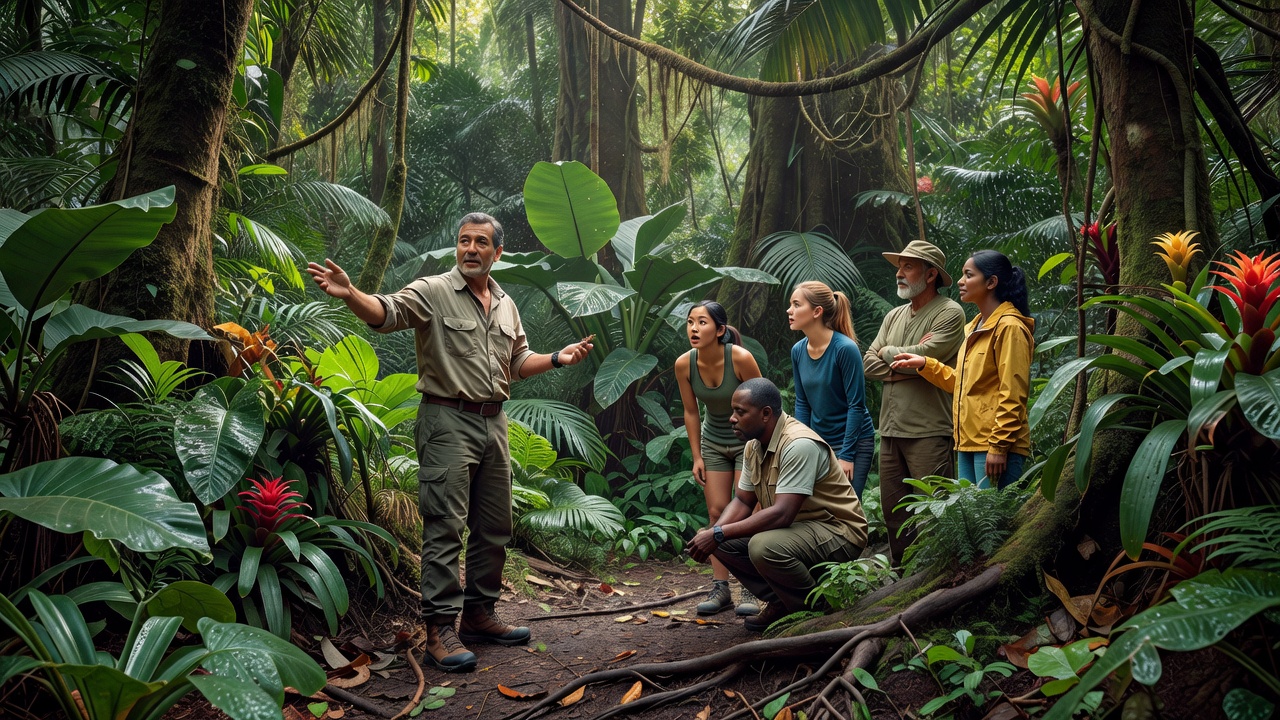
From an elevated platform, a forest can look free of human history. That impression is often misleading. Forest landscapes may hold homes, customary rights, working routes, protected sites and generations of ecological knowledge. A visitor’s short stay is one small event in a much longer relationship. Good interpretation helps make that relationship visible without treating people as another attraction.
Begin with who gets to decide
The word “local” is useful only when followed by detail. An experience may employ local guides while remaining externally owned. A community-owned lodge may contract some services from elsewhere. A conservation organisation may work with several neighbouring settlements whose interests are not identical. None of these arrangements can be understood from a single marketing adjective.
Ask who owns the business, who participates in management and how local partners describe the relationship. Listen for specific explanations rather than demanding that a guide disclose private financial information. Where a project publishes reports or community governance information, read them. Transparent relationships are more informative than a visitor’s assumption that buying a ticket automatically produces fair benefit.
Knowledge is not an unlimited resource
A guide may share plant names, seasonal observations, stories or practical knowledge. Sharing one explanation is not permission to record everything, publish it commercially or claim it as your own discovery. Some knowledge is restricted, sacred, family-held or simply not offered to visitors. A respectful question leaves room for the answer “that is not something we share.”
Ask before recording a conversation, photographing a person or attaching someone’s name to a story. Consent to a photograph is not necessarily consent to publication on a public account. Children require particular care and appropriate permission. Do not pressure a guide to arrange access to ceremonies, homes or restricted places for a more unusual photograph.
Examples are starting points, not templates
In Guyana, Surama and Rewa are well-known reference points for community-based tourism. The wider Rupununi region illustrates why a visitor should pay attention to the relationship between settlement, landscape, livelihoods and guiding. Nearby in the national tourism conversation, Iwokrama connects forest research, management and visitor experiences. These names represent distinct organisations and communities, not one interchangeable model.
In Ecuador, Napo Wildlife Center and Kapawi are examples worth researching when considering community ownership and tourism in Amazonian settings. In Peru, Posada Amazonas offers another frequently discussed community-partnership context. Read how each initiative describes its current governance and benefits. This journal does not claim affiliation, assess present financial arrangements or suggest that any one project speaks for all Indigenous peoples.
Follow the benefit beyond the ticket
Useful questions concern employment, guide development, procurement and local decision-making. Does the experience use locally owned accommodation or transport? Are interpreters credited for their expertise? Is there a clear explanation of any conservation levy? A visitor need not conduct an audit, but should be willing to distinguish a documented arrangement from a hopeful story.
Pay agreed prices and follow local guidance about tipping. Buying directly from a maker can be meaningful when the sale is welcome and fairly conducted; bargaining aggressively for a token saving can undermine that relationship. Avoid giving gifts to children or organising donations without asking an appropriate local organisation what is useful and how support should be managed.
Stewardship has practical boundaries
Stay on permitted routes, keep waste with you and follow guidance about wildlife observation. Do not feed animals or use an encounter to justify closer approach. Respect limits on sound, group movement and photography. Those boundaries are not obstacles to an authentic experience; they are part of how access can coexist with ecological and community priorities.
The United Nations Declaration on the Rights of Indigenous Peoples provides an important rights-based context, including the principle of free, prior and informed consent. A tourist’s personal request for a photograph is not equivalent to a community-level consent process. Recognising that difference helps avoid turning a complex right into a casual checklist item or assuming that one friendly encounter establishes wider permission.
Leave with a more careful story
When you describe your visit, name the people and organisations appropriately, where permission and context allow. Separate what you observed from what you were told, and avoid portraying a community as timeless, uniform or waiting to be discovered. People may use technology, pursue different livelihoods and disagree about tourism while maintaining deep relationships with their forest.
A good elevated journey changes more than your camera angle. It can help you ask whose work makes access possible, whose knowledge shapes the interpretation and whose decisions deserve respect after visitors leave. Those questions do not diminish the wonder of a canopy view. They give the view a place in a living human landscape.
Community voices & further reading
- Guyana Tourism Authority — starting points for Surama, Rewa and Rupununi tourism.
- Iwokrama International Centre — forest management and research context.
- Napo Wildlife Center — the initiative’s own account of its work.
- Kapawi — the initiative’s own visitor and community information.
- Rainforest Expeditions — Posada Amazonas partnership context.
- United Nations Declaration on the Rights of Indigenous Peoples — a rights framework, not a tourism certification.