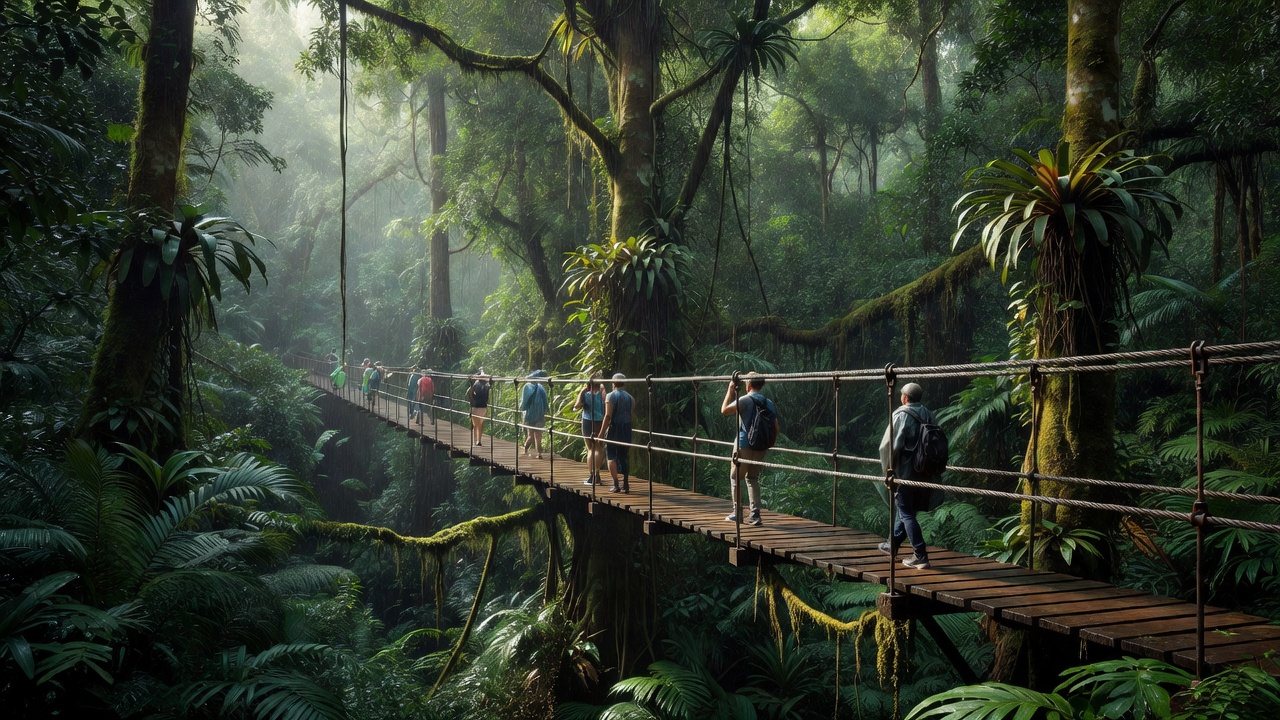
“Canopy tour” can describe a slow walk across bridges, a climb to an observation platform, a rope-access activity or a sequence of zip lines. These are not interchangeable experiences. Before comparing photographs, ask the operator to explain the route from arrival to return. The least visible part of an advertisement—the approach trail, staircase or waiting area—may matter most to your visit.
Walking above the ground
Elevated walkways connect platforms or follow a raised structure through the forest. Some bridges move perceptibly underfoot; others feel relatively rigid. Handrails, deck materials, widths and entry arrangements differ. A route may cross above a valley while remaining close to a hillside at another point, so a single advertised height rarely explains the whole experience.
Kakum National Park in Ghana is widely known for its canopy walkway. Iwokrama in Guyana provides another recognised canopy-walkway setting, linked to a broader forest landscape and interpretation. These names are useful starting points for research, not equivalent products. Consult the responsible visitor organisation for current access, restrictions and the exact activity available on your intended date.
Towers, platforms and rope access
An observation tower can offer time to watch birds or study the forest profile without moving between suspended bridges. However, reaching the platform may involve many steps and limited places to rest. Ask about landings, handrails, exposure and whether the return uses the same staircase. “Stationary viewing” describes the observation point, not necessarily an easy approach.
Rope-based access introduces a different set of skills, equipment and supervision needs. A harness is not evidence that two activities share the same operating system. Visitors should not attempt to adapt techniques from online articles or other trips. The operator must explain the activity, assess suitability and provide the relevant briefing. This journal does not teach climbing, anchor assessment or rescue methods.
Access is more than admission
A ticket being available does not mean a route meets a visitor’s access needs. Ask about gradients, surfaces, steps, bridge movement, rest opportunities and toilets. Someone who uses a mobility aid needs route-specific information, not a broad assurance that a walk is “easy.” The same is true for visitors with low vision, hearing differences, fatigue or a strong response to exposed heights.
Request descriptions or current photographs of the approach as well as the elevated section. Explain what information helps you decide, without feeling obliged to disclose more personal detail than necessary. Ask whether a ground-level alternative offers meaningful interpretation and whether companions can remain together. A well-matched visit may involve staying below the canopy rather than pushing through an unsuitable route.
Read the structure through its setting
In Sabah, the Rainforest Discovery Centre at Sepilok offers an example of elevated forest viewing within an interpretation setting. In Peninsular Malaysia, Taman Negara is associated with canopy-walkway tourism, but availability and operating arrangements can change. At places such as the Daintree in Australia, the visitor experience may instead centre on boardwalks, guided ground-level interpretation or other locally managed access.
The wider lesson is to resist collecting infrastructure names as if they guaranteed comparable conditions. A walkway is affected by its environment and management. Rain, wind, lightning, treefall and maintenance can change access. A closure is not a defect in your itinerary to negotiate around. It is a decision to respect, including when the sky appears clear at the entrance.
Questions about care, not amateur inspection
It is reasonable to ask who operates the structure, how maintenance and inspections are organised, how visitor numbers are managed and who makes closure decisions. It is not reasonable to assume that a brief visual check makes a visitor qualified to judge structural integrity. Nor should a confident guide’s manner substitute for clear answers about operating responsibility.
Ask what happens if someone wants to turn back, becomes distressed or cannot continue. The answer should be specific to that route. On-site instructions about spacing, movement, belongings and photography must come from the operator. Do not infer universal equipment standards from a photograph, or copy another group’s behaviour without hearing your own briefing.
Choose a pace that leaves room to notice
A thoughtful route offers more than a dramatic crossing. It creates opportunities to stop where permitted, hear the guide and observe without blocking others. Tell the operator if your main interest is natural history rather than an adrenaline-focused activity. The best elevated perspective is the one that suits your needs while leaving attention available for the forest and the people interpreting it.
Sources & destination starting points
- Forestry Commission of Ghana — national park management context, including Kakum.
- Iwokrama International Centre — forest, research and visitor context in Guyana.
- Sabah Forestry Department — forest interpretation and Rainforest Discovery Centre context.
- Department of Wildlife and National Parks, Peninsular Malaysia — Taman Negara information.
- Queensland Parks — Daintree park information and alerts.
Check the relevant organisation for current operations. These references are not endorsements or live access reports.