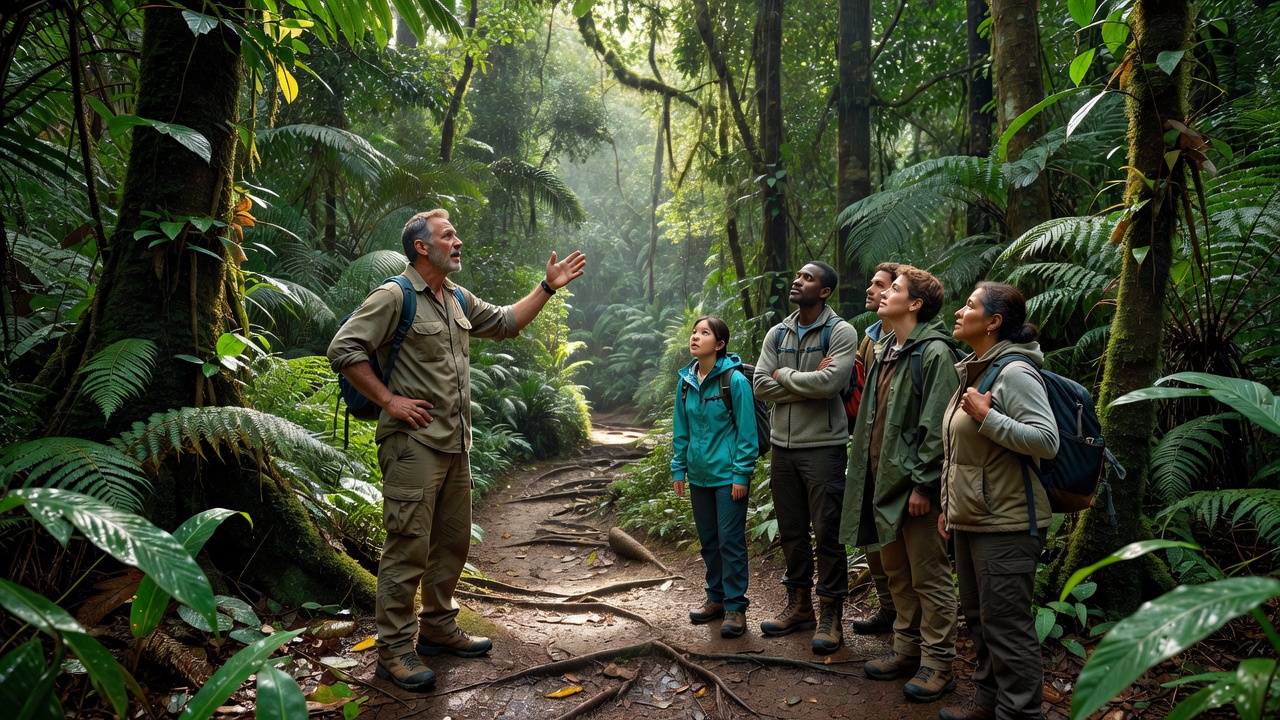
Trust on a guided rainforest visit is built through specific answers, not a promise that there is nothing to worry about. A thoughtful operator explains the activity, listens to your concerns and identifies limits. A thoughtful visitor shares relevant needs, follows instructions and accepts that weather or site conditions may change the plan. Neither role is served by pretending uncertainty does not exist.
Start with the actual activity
Ask for a plain-language description of what you will do. Will you walk across bridges, climb stairs, use ropes or travel on zip lines? How long is the approach? Are there exposed waiting areas? Does everyone return by the same route? Activity names often blur these distinctions, so ask for the sequence rather than relying on the phrase “canopy expedition.”
Then ask who is responsible for the visit. A booking platform, accommodation provider, guide and structure operator may be separate organisations. Knowing who supplies the instructions, manages equipment and decides on access makes later questions easier. Keep the responsible operator’s current contact details available, particularly if your plans involve independent transport to a remote meeting point.
Discuss fit before commitment
Tell the operator what you need to assess your participation. This might involve balance, mobility, fatigue, hearing, vision, a fear of heights or a relevant medical concern. You can ask for a private conversation. Do not assume a general description such as “family friendly” means the activity suits every child, adult or access requirement.
Age, height, weight and other eligibility rules vary by activity and provider; this journal does not set them. Request the current rules and the reasons for any information the operator requires. For personal medical suitability, consult a qualified clinician who understands your circumstances. An editorial checklist cannot decide whether a particular activity is appropriate for an individual.
Ask about competence without collecting badges
Useful questions include how guides are trained for their actual duties, how training is kept current and what emergency arrangements apply at that site. Ask how communication works between guides and what happens if a visitor cannot continue. A rehearsed slogan about safety is less informative than an explanation tied to the route, staffing and conditions.
ISO 21101 addresses safety management systems for adventure tourism, while ISO 21102 addresses competence for leaders and ISO 21103 concerns information for participants. These are reference points for understanding the kinds of responsibilities involved. Mentioning a standard does not prove certification or compliance. If an operator claims certification, ask who issued it, what its scope covers and whether it remains current.
Let the briefing be a real pause
On arrival, give the briefing your full attention. Ask for repetition or clarification before the group moves. Confirm the language used and tell the guide if you cannot hear. If equipment is supplied, its selection, fitting, checking and use must follow the operator’s procedures. Do not alter a system because something looked different on another trip or in a photograph.
Photography can compete with listening and balance. Ask when cameras or phones may be used, how belongings should be carried and whether any items must be left behind. There is no universal packing list for every elevated rainforest activity. Footwear, clothing, water and rain protection should be discussed with the operator in relation to the actual route and conditions.
Weather changes the conversation
Rainforest weather is not simply an atmospheric detail. Ask who monitors conditions, what triggers a pause or closure and how guests are informed. Lightning, wind, heavy rain or fallen trees can affect plans. Respect an operator’s decision to stop; do not pressure a guide to continue because a journey was expensive or a photograph feels important.
Understand cancellation and rescheduling terms before paying. Travel insurance also deserves careful reading: activity categories, altitude limits, exclusions and emergency arrangements can vary. Ask the insurer about the named activity rather than assuming a general policy includes it. For destination health and wider travel preparation, use current advice from relevant public health and government travel services.
Keep the option to stop
Ask in advance what happens if you decide not to begin, or want to stop partway through. The answer may depend on the route and must not be improvised by this journal. Good preparation includes knowing how to raise a concern and when the last straightforward exit occurs. Choosing a ground-level alternative can be a considered decision, not a failed adventure.
Finally, remember why you are there. A guide’s ability to explain a tree, listen to a question or make a conservative decision is part of the experience. When preparation is clear, you have more attention left for the people and living systems around you. Confidence should come from understanding your visit, not from being told that all visits are the same.
Standards & practical reading
- International Organization for Standardization — look up ISO 21101, ISO 21102 and ISO 21103 for their current scope and editions.
- TravelHealthPro — destination health information for UK travellers.
- UK Foreign Travel Advice — destination-specific travel information.
No standard eliminates risk. We do not certify operators, assess equipment or provide personal medical advice.